|
بخش I: Reading Comprehension درس ۴ کتاب کار زبان انگلیسی دهم
How to be a good traveler
Travel is about visiting new places and meeting new people. When
visiting a destination, a traveler should take care of people, places and
cultures. So, before any travel, we must pay attention to some points.
First, we must read as much as possible about the main tourist
attractions we are going to visit. Searching the Internet is an easy
way to know about them. Also, learning a few words and phrases of
the local language can be very useful, especially when we meet new
people there. When we meet local people, we must not forget that we are guests! So, we must respect their way of living. When visiting historical and
especially holy places, we must respect them, too. When we visit natural places such as lakes, forests and deserts, we
must protect the plants and wild animals. In this
way, every travel can be a great
experience for us.
پاسخ گام به گام و تشریحی بخش I: Reading Comprehension درس ۴ کتاب کار زبان انگلیسی دهم
این بخش شامل یک متن خواندنی دربارهٔ **چگونه یک مسافر خوب باشیم** ($\text{How to be a good traveler}$) و نکاتی برای رفتار در سفر است.
**ترجمه روان متن:**
سفر دربارهٔ بازدید از مکانهای جدید و ملاقات با افراد جدید است. هنگام بازدید از یک مقصد، یک مسافر باید مراقب مردم، مکانها و فرهنگها باشد. بنابراین، قبل از هر سفری، باید به نکاتی توجه کنیم. اول، باید تا حد امکان دربارهٔ جاذبههای اصلی توریستی که قصد بازدید از آنها را داریم، مطالعه کنیم. جستجو در اینترنت راه آسانی برای کسب اطلاعات دربارهٔ آنها است. همچنین، یادگیری چند کلمه و عبارت از زبان محلی میتواند بسیار مفید باشد، بهویژه هنگامی که در آنجا با افراد جدید ملاقات میکنیم. وقتی با مردم محلی ملاقات میکنیم، نباید فراموش کنیم که ما مهمان هستیم! بنابراین، باید به شیوهٔ زندگی آنها احترام بگذاریم. هنگام بازدید از مکانهای تاریخی و بهویژه مقدس، باید به آنها نیز احترام بگذاریم. وقتی از مکانهای طبیعی مانند دریاچهها، جنگلها و بیابانها بازدید میکنیم، باید از گیاهان و حیوانات وحشی محافظت کنیم. به این ترتیب، هر سفری میتواند یک تجربهٔ عالی برای ما باشد.
**نکات کلیدی و واژگان مهم:**
* $\text{destination}$: مقصد.
* $\text{tourist attractions}$: جاذبههای گردشگری.
* $\text{local language}$: زبان محلی.
* $\text{respect their way of living}$: به شیوهٔ زندگی آنها احترام بگذاریم.
* $\text{holy places}$: مکانهای مقدس.
* $\text{protect the plants and wild animals}$: از گیاهان و حیوانات وحشی محافظت کنیم.
***
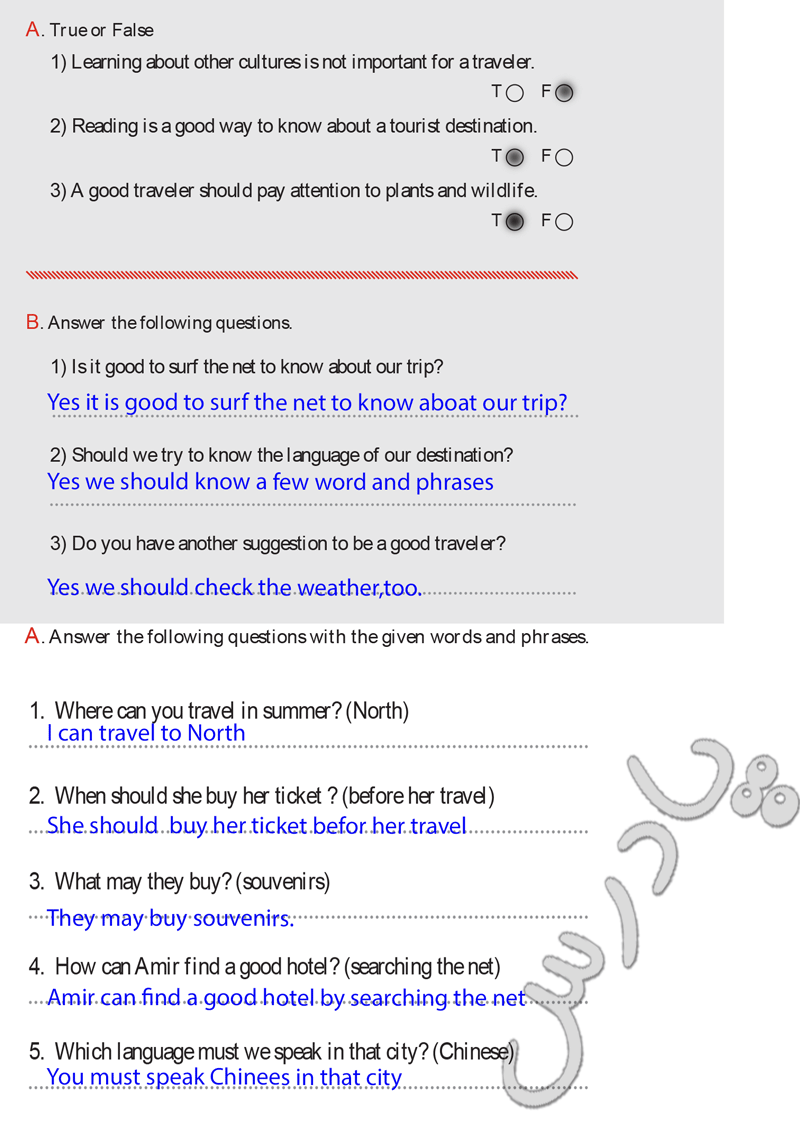
## A. True or False
1) $\text{Learning about other cultures is not important for a traveler.}$ $\text{T}quare ext{F}quare$
* **بررسی متن:** $\text{a traveler should take care of people, places and cultures.}$ $\rightarrow$ مراقبت از فرهنگها مهم است.
* **پاسخ صحیح:** $\text{F}$ (False) [cite: 1171]
2) $\text{Reading is a good way to know about a tourist destination.}$ $\text{T}quare ext{F}quare$
* **بررسی متن:** $\text{we must read as much as possible about the main tourist attractions}$ (باید تا حد امکان مطالعه کنیم.)
* **پاسخ صحیح:** $\text{T}$ (True) [cite: 1173]
3) $\text{A good traveler should pay attention to plants and wildlife.}$ $\text{T}quare ext{F}quare$
* **بررسی متن:** $\text{we must protect the plants and wild animals.}$ (باید از گیاهان و حیوانات محافظت کنیم.)
* **پاسخ صحیح:** $\text{T}$ (True) [cite: 1178]
***
## B. Answer the following questions.
1) $\text{Is it good to surf the net to know about our trip}?$
* **پاسخ:** $\text{Yes, it is. Searching the Internet is an easy way to know about them.}$ (بله. جستجو در اینترنت راه آسانی برای شناختن آنها است.) [cite: 1174]
2) $\text{Should we try to know the language of our destination}?$
* **پاسخ:** $\text{Yes, we should. Learning a few words and phrases of the local language can be very useful.}$ (بله. یادگیری چند کلمه و عبارت از زبان محلی میتواند بسیار مفید باشد.) [cite: 1175]
3) $\text{Do you have another suggestion to be a good traveler}?$
* **پاسخ (پیشنهادی):** $\text{Yes, I do. I think we should buy souvenirs from local shops to help local people. / We should keep natural places clean.}$
*(سؤال آخر سلیقهای است.)*
بخش II: Grammar A درس ۴ کتاب کار زبان انگلیسی دهم
A. Answer the following questions with the given words and phrases.
1. Where can you travel in summer? (North)
2. When should she buy her ticket? (before her travel)
3. What may they buy? (souvenirs)
4. How can Amir find a good hotel? (searching the net)
5. Which language must we speak in that city? (Chinese)
پاسخ گام به گام و تشریحی بخش II: Grammar A درس ۴ کتاب کار زبان انگلیسی دهم
این تمرین بر روی پاسخ دادن به سؤالات **اطلاعاتی** ($\text{Wh Questions}$) با استفاده از **افعال کمکی وجهی** ($\text{Modal Verbs}$) مانند $\text{can, should, may, must}$ تمرکز دارد.
**قانون:** افعال کمکی وجهی در پاسخهای خبری تکرار میشوند و بعد از آنها فعل اصلی به صورت **پایه** میآید.
1. $\text{Where can you travel in summer}?$ ($\text{can}$: توانستن/امکان)
* **پاسخ:** $\text{I can travel to the North in summer.}$ (میتوانم به شمال سفر کنم.)
2. $\text{When should she buy her ticket}?$ ($\text{should}$: توصیه/الزام اخلاقی)
* **پاسخ:** $\text{She should buy her ticket before her travel.}$ (باید قبل از سفرش بلیط بخرد.)
3. $\text{What may they buy}?$ ($\text{may}$: احتمال/اجازه)
* **پاسخ:** $\text{They may buy some souvenirs.}$ (ممکن است سوغاتی بخرند.)
4. $\text{How can Amir find a good hotel}?$ ($\text{can}$: توانستن)
* **پاسخ:** $\text{Amir can find a good hotel by searching the net.}$ (امیر میتواند با جستجو در نت هتل پیدا کند.)
5. $\text{Which language must we speak in that city}?$ ($\text{must}$: الزام قوی)
* **پاسخ:** $\text{We must speak Chinese in that city.}$ (باید در آن شهر به زبان چینی صحبت کنیم.)
**واژگان جدید:** $\text{souvenirs}$: سوغاتیها. $\text{searching the net}$: جستجو در اینترنت.
بخش II: Grammar D و E درس ۴ کتاب کار زبان انگلیسی دهم
D. Read the following text. Complete it with appropriate prepositions.
Armin is a student. He lives ... Shahrood. He usually
wakes up ... 5 o'clock ... the morning.
... Thursdays and Fridays, he wakes up later because he
doesn't go to school.
... their house, there is a stadium.
He goes there to play football.
... noon, he comes back ... home and rests.
E. Now answer the following questions.
1. Where does Armin live?
2. When does he usually wake up?
3. Where is the stadium?
پاسخ گام به گام و تشریحی بخش II: Grammar D و E درس ۴ کتاب کار زبان انگلیسی دهم
این تمرین بر روی استفادهٔ صحیح از **حروف اضافه** ($\text{Prepositions}$) برای **زمان** ($\text{at, in, on}$) و **مکان** ($\text{in, near, at}$) در متن و درک مطلب از آن تمرکز دارد.
## D. تکمیل متن
$\text{Armin is a student. He lives}$ **in** $\text{Shahrood. He usually wakes up}$ **at** $\text{5 o'clock}$ **in** $\text{the morning.}$ **On** $\text{Thursdays and Fridays, he wakes up later because he doesn't go to school.}$ **Near** $\text{their house, there is a stadium. He goes there to play football.}$ **At** $\text{noon, he comes back}$ **to** $\text{home and rests.}$
* **نکات حروف اضافه:**
* $\text{in}$ $\text{Shahrood}$ (در شهر)
* $\text{at 5 o'clock}$ (برای ساعت)
* $\text{in the morning}$ (برای دورههای روز)
* $\text{On Thursdays}$ (برای روزهای هفته)
* $\text{Near their house}$ (نزدیک خانه)
* $\text{At noon}$ (برای ظهر)
* $\text{comes back}$ **to** $\text{home}$ (یا $\text{comes back home}$ بدون حرف اضافه)
***
## E. پاسخ به سؤالات
1. $\text{Where does Armin live}?$
* **پاسخ:** $\text{He lives in Shahrood.}$
2. $\text{When does he usually wake up}?$
* **پاسخ:** $\text{He usually wakes up at 5 o'clock in the morning (on weekdays). / He wakes up later on Thursdays and Fridays.}$
3. $\text{Where is the stadium}?$
* **پاسخ:** $\text{It is near their house.}$
*(توجه: تمام پاسخها در زمان حال ساده ($\text{Simple Present}$) داده شدهاند.)*
بخش III: Vocabulary A و B درس ۴ کتاب کار زبان انگلیسی دهم
A. Find 10 words related to travel.
pilgrim, scientist, destination, ticket, check in,
attraction, plant, war, course, poem, angry,
creation, baggage, brave, passport, plane, vacation,
invention, word, train
B. One odd out.
1. travel/trip/nation/journey
2. local/international/domestic/national
3. hospitable / kind / polite / angry
4. jungle/town/ desert / plain
5. Europe / Asia / Spain / Africa
پاسخ گام به گام و تشریحی بخش III: Vocabulary A و B درس ۴ کتاب کار زبان انگلیسی دهم
این تمرین بر روی واژگان مرتبط با **سفر، مکانها و شخصیتها** تمرکز دارد.
## A. پیدا کردن ۱۰ کلمه مرتبط با سفر
کلمات مرتبط با سفر ($\text{Travel}$):
1. **$\text{pilgrim}$** (زائر)
2. **$\text{destination}$** (مقصد)
3. **$\text{ticket}$** (بلیط)
4. **$\text{check in}$** (پذیرش شدن)
5. **$\text{attraction}$** (جاذبه)
6. **$\text{baggage}$** (چمدان/بار)
7. **$\text{passport}$** (گذرنامه)
8. **$\text{plane}$** (هواپیما)
9. **$\text{vacation}$** (تعطیلات)
10. **$\text{train}$** (قطار)
*(کلمات $\text{scientist, plant, war, course, poem, angry, creation, brave, invention, word}$ نامرتبط هستند.)*
***
## B. کلمه نامرتبط ($\text{One odd out}$)
1. $\text{travel/trip/nation/journey}$
* **تحلیل:** $\text{travel, trip, journey}$ همگی به معنای **سفر** هستند، اما $\text{nation}$ (ملت/کشور) نامرتبط است.
* **پاسخ صحیح:** $\text{nation}$
2. $\text{local/international/domestic/national}$
* **تحلیل:** $\text{local}$ (محلی)، $\text{international}$ (بینالمللی)، $\text{domestic}$ (داخلی)، $\text{national}$ (ملی) همگی **صفاتی** هستند که نوع یک منطقه یا سفر را مشخص میکنند. $\text{domestic}$ و $\text{national}$ مترادف داخلی هستند. از نظر معنایی همه مرتبط هستند، اما $\text{international}$ (بینالمللی) از نظر حوزه با بقیه که داخلی هستند متفاوت است. $\text{domestic}$ و $\text{local}$ به شدت مرتبط با سفر نیستند.
* **پاسخ صحیح:** $\text{local}$ (زیرا به یک موقعیت خاص اشاره میکند، نه دامنه جغرافیایی گسترده.)
3. $\text{hospitable / kind / polite / angry}$
* **تحلیل:** $\text{hospitable}$ (مهماننواز)، $\text{kind}$ (مهربان) و $\text{polite}$ (مؤدب) همگی صفات **مثبت** شخصیتی هستند، اما $\text{angry}$ (عصبانی) یک صفت **منفی** است.
* **پاسخ صحیح:** $\text{angry}$
4. $\text{jungle/town/ desert / plain}$
* **تحلیل:** $\text{jungle}$ (جنگل)، $\text{desert}$ (بیابان) و $\text{plain}$ (دشت) همگی **مکانهای طبیعی** هستند، اما $\text{town}$ (شهر) یک **مکان ساخته شده توسط انسان** است.
* **پاسخ صحیح:** $\text{town}$
5. $\text{Europe / Asia / Spain / Africa}$
* **تحلیل:** $\text{Europe, Asia, Africa}$ همگی **قاره** هستند، اما $\text{Spain}$ (اسپانیا) یک **کشور** است.
* **پاسخ صحیح:** $\text{Spain}$
بخش III: Vocabulary C و D درس ۴ کتاب کار زبان انگلیسی دهم
C. Match columns A and B.
A | B
---|---
summer | country
historical | vacation
suitable | websites
check | choice
four-season | sites
have | suggestions
D. Put the words in three groups considering their means of
transportation.
bus, airplane, ship, train,
balloon, boat, helicopter, bicycle
Land
Air
Sea
پاسخ گام به گام و تشریحی بخش III: Vocabulary C و D درس ۴ کتاب کار زبان انگلیسی دهم
این تمرین بر روی تطبیق کلمات برای ساختن **عبارات اسمی/فعلی** مرتبط با سفر و دستهبندی **وسایل حمل و نقل** تمرکز دارد.
## C. تطبیق ستونها
1. $\text{summer} \rightarrow$ **$\text{vacation}$** ($\text{summer vacation}$: تعطیلات تابستانی)
2. $\text{historical} \rightarrow$ **$\text{sites}$** ($\text{historical sites}$: مکانهای تاریخی)
3. $\text{check} \rightarrow$ **$\text{websites}$** ($\text{check websites}$: وبسایتها را چک کردن)
4. $\text{suitable} \rightarrow$ **$\text{choice}$** ($\text{suitable choice}$: انتخاب مناسب)
5. $\text{four-season} \rightarrow$ **$\text{country}$** ($\text{four-season country}$: کشور چهارفصل)
6. $\text{have} \rightarrow$ **$\text{suggestions}$** ($\text{have suggestions}$: پیشنهاد داشتن)
| $\text{A}$ | $\text{B}$ |
| :--- | :--- |
| $\text{summer}$ | $\text{vacation}$ |
| $\text{historical}$ | $\text{sites}$ |
| $\text{suitable}$ | $\text{choice}$ |
| $\text{check}$ | $\text{websites}$ |
| $\text{four-season}$ | $\text{country}$ |
| $\text{have}$ | $\text{suggestions}$ |
***
## D. دستهبندی وسایل حمل و نقل
| $\text{Land}$ (زمینی) | $\text{Air}$ (هوایی) | $\text{Sea}$ (دریایی) |
| :--- | :--- | :--- |
| $\text{bus}$ (اتوبوس) | $\text{airplane}$ (هواپیما) | $\text{ship}$ (کشتی) |
| $\text{train}$ (قطار) | $\text{balloon}$ (بالن) | $\text{boat}$ (قایق) |
| $\text{bicycle}$ (دوچرخه) | $\text{helicopter}$ (هلیکوپتر) | |
بخش III: Vocabulary E درس ۴ کتاب کار زبان انگلیسی دهم
E. Order the following means of transportation based on their speed.
(from the fastest to the slowest)
1.
2.
3.
4.
5.
6.
پاسخ گام به گام و تشریحی بخش III: Vocabulary E درس ۴ کتاب کار زبان انگلیسی دهم
این تمرین بر روی **مرتبسازی وسایل حمل و نقل** بر اساس **سرعت** آنها، از **سریعترین** به **کندترین**، تمرکز دارد. (بر اساس تصویر)
**وسایل حمل و نقل در تصویر:** $\text{train, car, airplane, bicycle, bus, ship}$
**ترتیب منطقی سرعت:**
1. **$\text{Airplane}$** (سریعترین)
2. **$\text{Train}$** (سریعتر از خودرو در مسافت طولانی و اتوبوس/قطارهای سریعالسیر)
3. **$\text{Car}$**
4. **$\text{Bus}$**
5. **$\text{Ship}$**
6. **$\text{Bicycle}$** (کندترین)
*(توجه: سرعت کشتیها بسته به نوعشان متفاوت است، اما معمولاً کندتر از وسایل حمل و نقل زمینی با موتور هستند. همچنین قطار میتواند سریعتر از ماشین باشد.)*
بخش III: Vocabulary F و G درس ۴ کتاب کار زبان انگلیسی دهم
F. Fill in the blanks with the given words.
range, cultures, suggestion, attracts,
probably, famous
1. Egypt is ... for its Pyramids.
2. Amazing nature of Iran ... many tourists.
3. We should respect the languages and ... of other countries.
4. We can do a ... of activities in our free time.
5. Do you have any ... to solve the problem?
G. Unscramble the following sentences.
1. famous / is / China / the Great Wall/for/.
2. Shiraz/sites/ historical / many / and /an amazing nature / has /.
3. attracts / a lot of / Hamedan / tourists / from / of Iran / cities / other /.
4. to Mashhad and Qom / travel / to go to / many Muslims / shrines / holy /.
5. is/ the best / what / souvenir / your city / of /?
پاسخ گام به گام و تشریحی بخش III: Vocabulary F و G درس ۴ کتاب کار زبان انگلیسی دهم
این تمرین بر روی تکمیل جملات با واژگان و سپس بازسازی جملات بههمریخته تمرکز دارد.
## F. تکمیل جملات
* **واژگان:** $\text{range}$ (محدوده/طیف)، $\text{cultures}$ (فرهنگها)، $\text{suggestion}$ (پیشنهاد)، $\text{attracts}$ (جذب میکند)، $\text{probably}$ (احتمالاً)، $\text{famous}$ (مشهور).
1. $\text{Egypt is}$ **famous** $\text{for its Pyramids.}$ (مصر به خاطر اهرامش **مشهور** است.)
2. $\text{Amazing nature of Iran}$ **attracts** $\text{many tourists.}$ (طبیعت شگفتانگیز ایران گردشگران زیادی را **جذب میکند**.)
3. $\text{We should respect the languages and}$ **cultures** $\text{of other countries.}$ (ما باید به زبانها و **فرهنگهای** کشورهای دیگر احترام بگذاریم.) [cite: 1171]
4. $\text{We can do a}$ **range** $\text{of activities in our free time.}$ (ما میتوانیم طیف وسیعی از فعالیتها را در اوقات فراغت خود انجام دهیم.)
5. $\text{Do you have any}$ **suggestion** $\text{to solve the problem}?$ (آیا **پیشنهادی** برای حل مشکل دارید؟)
## G. بازسازی جملات ($\text{Unscrambling}$)
1. $\text{famous / is / China / the Great Wall/for/.}$
* **پاسخ صحیح:** $\text{China is famous for the Great Wall.}$
2. $\text{Shiraz/sites/ historical / many / and /an amazing nature / has /.}$
* **پاسخ صحیح:** $\text{Shiraz has many historical sites and an amazing nature.}$
3. $\text{attracts / a lot of / Hamedan / tourists / from / of Iran / cities / other /.}$
* **پاسخ صحیح:** $\text{Hamedan attracts a lot of tourists from other cities of Iran.}$
4. $\text{to Mashhad and Qom / travel / to go to / many Muslims / shrines / holy /.}$
* **پاسخ صحیح:** $\text{Many Muslims travel to Mashhad and Qom to go to holy shrines.}$
5. $\text{is/ the best / what / souvenir / your city / of /}?$
* **پاسخ صحیح:** $\text{What is the best souvenir of your city}?$ (بهترین سوغاتی شهر شما چیست؟)
بخش IV: Pronunciation درس ۴ کتاب کار زبان انگلیسی دهم
Ask and answer with contrastive stress and appropriate intonation.
1. Which country are you from, Iran or Italy?
2. Where do you go, Isfahan or Yazd?
3. Which color do you like more, yellow or brown?
4. What do you want to have, spaghetti or kebab?
5. Should I check it online or offline?
پاسخ گام به گام و تشریحی بخش IV: Pronunciation درس ۴ کتاب کار زبان انگلیسی دهم
این بخش بر روی تمرین **تأکید متضاد** ($\text{Contrastive Stress}$) و **لحن صعودی-افتان** ($\text{Rising-Falling Intonation}$) در سؤالات **انتخابی** ($\text{Choice Questions}$) تمرکز دارد.
**قاعده:** در سؤالات انتخابی (با $\text{or}$)، لحن بر روی گزینهٔ اول **صعودی** و بر روی گزینهٔ دوم **افتان** است.
**پاسخها (برای تمرین گفتاری):**
1. $\text{Which country are you from, Iran} (\text{Rising}) \text{or Italy} (\text{Falling}) ext{?}$
* **پاسخ:** $\text{I am from Iran.}$ (یا $\text{Italy.}$) $\rightarrow$ با لحن افتان
2. $\text{Where do you go, Isfahan} (\text{Rising}) \text{or Yazd} (\text{Falling}) ext{?}$
* **پاسخ:** $\text{I go to Isfahan.}$ $\rightarrow$ با لحن افتان
3. $\text{Which color do you like more, yellow} (\text{Rising}) \text{or brown} (\text{Falling}) ext{?}$
* **پاسخ:** $\text{I like yellow more.}$ $\rightarrow$ با لحن افتان
4. $\text{What do you want to have, spaghetti} (\text{Rising}) \text{or kebab} (\text{Falling}) ext{?}$
* **پاسخ:** $\text{I want to have kebab.}$ $\rightarrow$ با لحن افتان
5. $\text{Should I check it online} (\text{Rising}) \text{or offline} (\text{Falling}) ext{?}$
* **پاسخ:** $\text{You should check it online.}$ $\rightarrow$ با لحن افتان
بخش V: Writing A درس ۴ کتاب کار زبان انگلیسی دهم
A. Change the following adjectives into adverbs. Pay attention to their
spelling.
quick
real
angry
easy
probable
good
careless
پاسخ گام به گام و تشریحی بخش V: Writing A درس ۴ کتاب کار زبان انگلیسی دهم
این تمرین بر روی تبدیل **صفت** ($\text{Adjective}$) به **قید حالت** ($\text{Adverb of Manner}$) با افزودن پسوند $\text{-ly}$ و رعایت قوانین املایی تمرکز دارد.
**قوانین املایی:**
* صفتهای با $\text{y}$ پایانی (مانند $\text{angry}$): $\text{y} \rightarrow ext{i} + ext{ly}$.
* صفتهای با $\text{le}$ پایانی (مانند $\text{probable}$): $\text{e} \rightarrow ext{y}$.
* صفتهای بیقاعده (مانند $\text{good}$): شکل قیدی خاص دارند.
| $\text{Adjective (صفت)}$ | $\text{Adverb (قید حالت)}$ |
| :--- | :--- |
| $\text{quick}$ (سریع) | $\text{quickly}$ (به سرعت) |
| $\text{real}$ (واقعی) | $\text{really}$ (واقعاً) |
| $\text{angry}$ (عصبانی) | $\text{angrily}$ (با عصبانیت) |
| $\text{easy}$ (آسان) | $\text{easily}$ (به آسانی) |
| $\text{probable}$ (محتمل) | $\text{probably}$ (احتمالاً) |
| $\text{good}$ (خوب) | $\text{well}$ (خوب/به خوبی) - **بیقاعده** |
| $\text{careless}$ (بیدقت) | $\text{carelessly}$ (با بیدقتی) |
![[ExerciseImg1tilte]](https://static.paadars.com/files/Courses/l10/english10-lesson4-2.png "[ExerciseImg1tilte]")
![[ExerciseImg2tilte]](https://static.paadars.com/files/Courses/l10/english10-lesson4-3.png "[ExerciseImg2tilte]")
![[ExerciseImg3tilte]](https://static.paadars.com/files/Courses/l10/english10-lesson4-4.png "[ExerciseImg3tilte]")


